
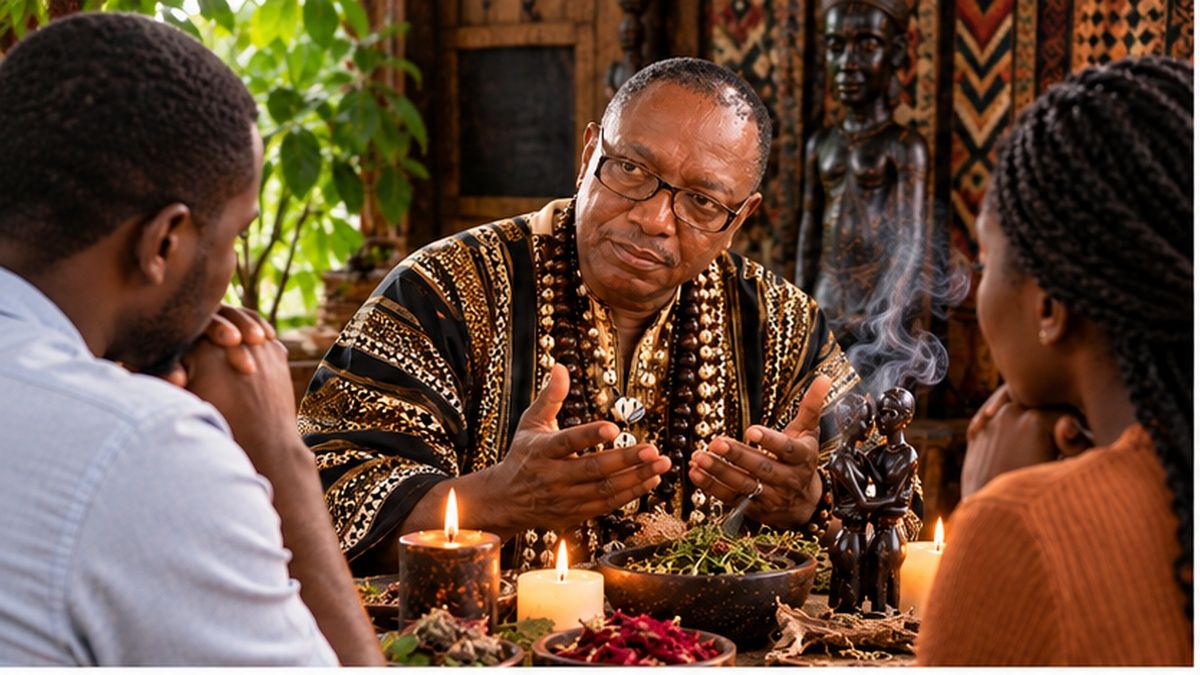
A Clear, Personal and Respectful Process
Every situation is different, so I do not begin by assuming that a particular service is right for you.
My approach starts with listening, continues with careful consideration and ends with clear information about whether I believe I can assist.
The process is designed to help you understand what to expect before deciding whether to proceed.

What I Do
My work includes traditional African spiritual guidance relating to:
Step 1: Tell Me What Is Happening
You can begin by explaining your situation in your own words.
You may wish to describe:
- what has happened
- how long the situation has been affecting you
- who is involved
- what you have already tried
- what you would like to change
- what outcome you are hoping for
You do not need to use spiritual terminology or choose a service before contacting me.
The more accurately you describe your circumstances, the easier it is to consider whether my services are relevant.
Step 2: I Review Your Circumstances
After receiving your information, I consider the situation carefully.
This may involve looking at:
- the nature of the concern
- whether the matter falls within my area of practice
- whether the requested service is appropriate
- whether practical or personal issues should be considered first
- whether another type of professional support may be more suitable
I do not treat every request as identical.
A service that may be relevant to one person may not be appropriate for someone else.
Step 3: I Explain the Available Service
If I believe I can assist, I will explain the service that appears most relevant to your circumstances.
This explanation may include:
- the general purpose of the work
- what the process involves
- what information may be needed
- the expected preparation
- the cost
- the estimated timeframe for carrying out the work
- any relevant limitations
The purpose of this explanation is to help you make an informed decision.
You should have an opportunity to ask questions before deciding whether to proceed.
Step 4: You Decide Whether to Proceed
You are not required to proceed simply because you have contacted me or received information about a service.
The decision is yours.
You should only proceed if you understand what is being offered, what it costs and what spiritual work can and cannot reasonably promise.
If you are uncertain, you may take time to consider your decision.
I do not support pressure, intimidation or repeated demands for payment.
Step 5: I Carry Out the Work Personally
If you choose to proceed, I personally carry out the spiritual work associated with the agreed service.
The nature of the work depends on the service and the circumstances described.
Preparation may involve traditional practices, prayer, reflection, symbolic materials, or other elements associated with my approach.
I will not describe spiritual work as medical treatment, psychological treatment, or a guaranteed method of changing another person’s behaviour.
Step 6: Communication During the Process
Clear communication is important throughout the process.
Where appropriate, I will provide information about:
- whether the work has begun
- whether additional information is required
- whether the agreed process has been completed
- any practical next steps that have been discussed
Communication does not mean that a particular result can be guaranteed.
It also does not mean that another person will act in a specific way or within a specific timeframe.

What I Need From You
A consultation is most useful when the information provided is honest and complete.
Please try to communicate clearly about:
- your relationship to the people involved
- the history of the situation
- any previous spiritual services you have purchased
- any threats, harassment, or safety concerns
- whether there are legal proceedings or protective orders
- whether you are receiving medical or mental-health support
- what you realistically expect from the service
You do not need to share information that you are uncomfortable providing.
However, withholding important details may make it more difficult to assess whether a service is appropriate.
What I Do Not Do
There are requests that I will not accept.
I do not offer services intended to:
- force someone to love you
- control another person’s thoughts
- make someone become obsessed with you
- cause harm, illness, or misfortune
- threaten or intimidate another person
- interfere with legal proceedings
- encourage harassment or stalking
- replace emergency, medical or mental-health care
- guarantee a specific person’s actions
- guarantee marriage, reconciliation or any other relationship outcome
If a request involves danger, coercion or harm, I may decline to provide a service.
Spiritual Work and Personal Responsibility
Spiritual services may be meaningful to people who choose to use them, but they do not remove the importance of personal responsibility and practical decision-making.
A consultation cannot make decisions for you.
It cannot replace honest communication, appropriate boundaries, or professional advice.
In relationship matters, you may still need to consider:
- whether communication is safe
- whether the relationship is respectful
- whether trust can be rebuilt
- whether both people want to continue
- whether counselling or other support may be useful
- whether ending contact is the healthier option
Spiritual work should not be used to justify remaining in an unsafe or abusive situation.
When Professional Support May Be More Appropriate
There are circumstances in which you should seek qualified professional help rather than relying on spiritual services.
Contact an appropriate professional if you are experiencing:
- immediate danger
- threats or violence
- thoughts of harming yourself or another person
- severe anxiety, depression or confusion
- medical symptoms
- financial or legal problems
- domestic abuse
- stalking or harassment
- concerns involving children or vulnerable adults
If there is an immediate risk to your safety, contact local emergency services or a trusted person who can help you directly.
Spiritual services are not emergency services and should not be treated as a substitute for urgent support.
Privacy and Personal Information
When you contact HerbalHealer, you may choose to share personal information about your circumstances.
Please avoid sending information that is not necessary for your enquiry.
You should not send:
- passwords
- banking PINs
- full payment-card details
- identity documents unless specifically requested through an appropriate secure process
- private information about another person that you do not have permission to share
Information provided during a consultation should be treated respectfully.
For more information about how personal information is handled, please review the website’s Privacy Policy.
What Does “Dr.” Mean Here?
You may see me referred to as Dr. Carlos Mukuru in some contexts.
I want to make the meaning clear.
In Uganda and within some African cultural contexts, the Luganda term Musawo can be used for a traditional healer or practitioner and is sometimes translated into English as “Doctor.”
In this context, it is a cultural/traditional designation.
It is not a claim that I am a medical doctor, nor should it be understood as an academic medical qualification.
I believe clients deserve to understand exactly who they are dealing with.
Traditional Practice and Modern Life
Traditional spiritual practice exists alongside the practical realities of modern life.
If you are dealing with a relationship problem, spiritual guidance does not mean that you should stop communicating with your partner.
If trust has been damaged, spiritual practice does not eliminate the need for honesty and changed behaviour.
If a relationship has become unsafe, spiritual work should not replace seeking safety.
If you have a medical or mental-health concern, you should seek appropriate qualified professional care.
Spiritual practice has its place, but it should not be presented as a replacement for every other form of help.
Costs and Payments
The cost of a service should be explained before you decide to proceed.
You should understand:
- the total price
- what the price includes
- whether any additional materials or charges may apply
- the accepted payment method
- whether payment is refundable
- what happens if you decide not to continue
Do not send additional payment because someone claims that an unexpected curse, emergency, or hidden problem has appeared and that more money is required immediately.
If you receive a request that seems inconsistent with the information originally provided, ask for clarification before making any further payment.
A Respectful and Voluntary Process
I aim to provide a process that is clear, respectful and voluntary.
You should feel able to:
- ask questions
- request clarification
- decline a service
- take time before deciding
- explain if your circumstances change
- seek professional support elsewhere
- stop communicating if you no longer wish to proceed
You should never feel that you must continue because you have already paid, because you have been frightened or because someone has told you that refusing will cause harm.
In Three Stages
Listen
Understand your circumstances and what you are hoping to address.
Assess
Consider whether my services are relevant and whether I am an appropriate person to assist.
Explain
Provide clear information so that you can decide whether to proceed.
Before You Contact Me
Before submitting an enquiry, consider what you would like help with and what information you are comfortable sharing.
You may find it useful to write down:
- the main concern
- the people involved
- the relevant history
- what you want to understand
- what you have already tried
- any safety or legal concerns
- the questions you want to ask
You do not need to have everything resolved before contacting me.
You only need to describe your situation as clearly as you can.
After You Contact Me
I will review the information you provide and respond with the next appropriate step.
That may involve:
- asking for clarification
- explaining a relevant service
- providing practical information
- advising that my services are not suitable
- suggesting that you seek another form of support
A response does not create an obligation to purchase a service.
You remain free to decide what is right for you.
My Commitment
I will aim to:
- communicate clearly
- treat your circumstances with respect
- avoid guaranteed-result claims
- explain costs before work begins
- avoid encouraging coercion or harm
- perform agreed work personally
- acknowledge the limits of spiritual services
- tell you when I do not believe I can assist
I cannot control another person’s choices, and I cannot promise a particular outcome.
What I can offer is a personal consultation informed by my tradition, experience, and understanding of the circumstances you choose to share.
Begin With a Conversation
If you would like to discuss your situation, you can contact me privately.
Explain what has happened, what you are experiencing, and what you would like to understand or change.
I will review your enquiry and explain whether I believe one of my services is appropriate.
Request a Private Consultation