

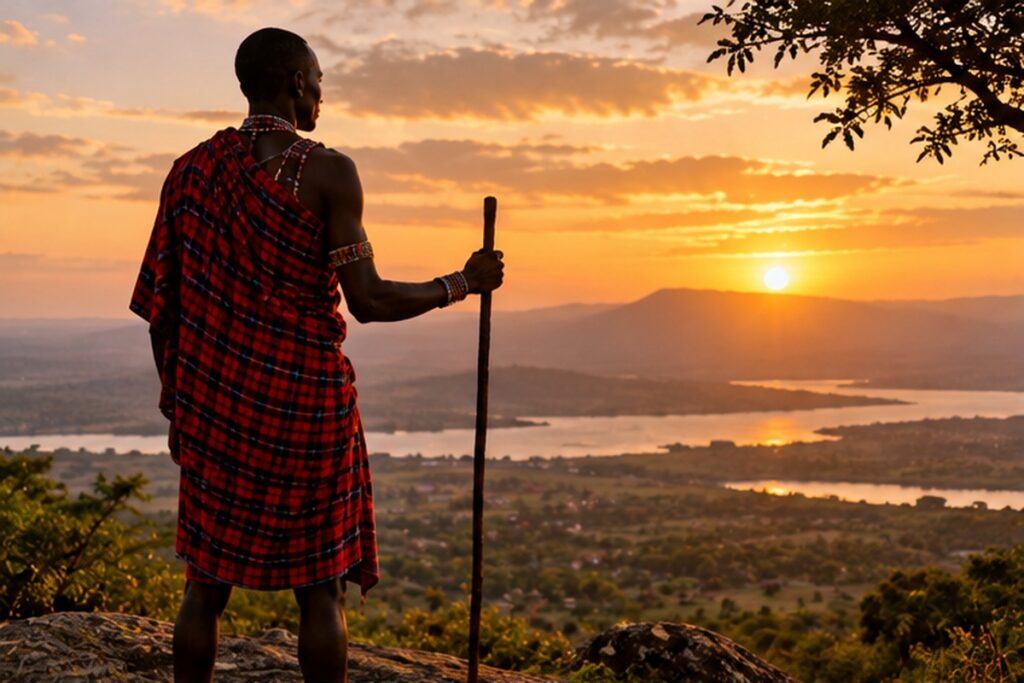
What is African spirituality?
There is no single answer because African spirituality is not one religion or one standardized belief system.
Africa contains thousands of communities, languages, histories, and cultural traditions. Spiritual beliefs and practices have therefore developed differently across regions and societies.
Scholars of African religions emphasize this diversity. Harvard’s Center for the Study of World Religions, for example, describes significant internal diversity among African religious traditions while identifying recurring ways that spiritual and everyday life can be closely connected.
The term African spirituality is therefore best understood as a broad description covering different indigenous religious and spiritual traditions, rather than as the name of one unified religion.
This article explores some recurring themes while avoiding the assumption that every African community believes the same things.
African Spirituality Is Not One Religion
One of the most important things to understand is that there is no single African spiritual system.
Traditional beliefs have developed among communities across:
- West Africa
- East Africa
- Central Africa
- Southern Africa
- North Africa
And even within the same country, different ethnic and cultural communities may have different traditions.
Academic research similarly cautions against treating “African spirituality” as a simple, uniform category. A study published by researchers at Durban University of Technology describes African spirituality as a diverse collection of beliefs, traditions, and practices that need to be understood within their cultural context.
This matters because a practice found in one community should not automatically be described as a universal African tradition.
What Does African Spirituality Generally Explore?
Although traditions differ, African spiritual traditions may involve ideas concerning:
- relationships between people and the spiritual world
- ancestors
- community and family
- moral responsibilities
- nature and the environment
- ritual and ceremony
- healing traditions
- divination
- rites of passage
- protection
- identity and belonging
These themes appear in different forms and with different meanings across communities.
Research from Harvard’s Center for the Study of World Religions notes that in many Africana religious traditions, the distinction between everyday life and religious life has historically been less pronounced than the distinction commonly assumed in some Western religious frameworks.
That helps explain why spirituality can appear in areas of life such as family, marriage, health, community responsibilities, and ceremonies.
Community Has an Important Place
Many African cultural and spiritual traditions place considerable importance on relationships between individuals, families, and communities.
Spirituality may therefore be connected to:
- family responsibilities
- clan identity
- community ceremonies
- rites of passage
- marriage
- birth
- death
- remembrance of ancestors
- moral responsibilities
This does not mean that every African culture organizes spirituality around the same ideas.
Rather, community is one recurring theme that researchers have identified when studying African religious traditions.
A 2025 academic study of African spirituality in a rural South African community, for example, examined spiritual beliefs and practices through interviews with community members and traditional leaders, illustrating how spirituality can be embedded within a particular community’s cultural life.

Traditional Healers and Spiritual Practitioners
Traditional healers and spiritual practitioners have existed in many African societies, although their roles and names vary considerably.
Some practitioners work primarily with traditional plant knowledge.
Others may combine herbal knowledge with spiritual practices, divination, counselling, ritual or other culturally specific practices.
It is therefore misleading to assume that every traditional healer performs the same role.
The World Health Organization describes traditional medicine broadly as systems of health-related knowledge, practices and philosophies originating in different historical and cultural contexts. WHO also emphasizes that traditional medicine varies considerably between settings and that questions of safety, quality and evidence remain important.
In Africa, traditional practitioners can also have significant cultural legitimacy within their communities. WHO’s African Regional Office has described traditional medicine as culturally grounded and widely used in many African communities.
What Does “Musawo” Mean?
In Uganda, the word musawo has a particularly interesting cultural and linguistic history.
The word can be used in Luganda in connection with a healer or health worker, and its meaning depends on context.
Academic research on Buganda has documented the use of musawo for different kinds of practitioners, including local healers. One study of contemporary Buganda describes musawo muganda in the context of a local healer and distinguishes this from terms used for Western-trained medical practitioners.
This is important when discussing Carlos Mukuru.
Carlos is described on HerbalHealer as an African spiritual practitioner, not as a medical doctor.
The word “Musawo” should therefore not be used on this website in a way that falsely suggests that Carlos possesses a medical degree or medical registration.
For HerbalHealer, the clearest international wording is:
Carlos Mukuru — African Spiritual Practitioner
This respects the cultural terminology while avoiding confusion for international readers.
African Spirituality and Ancestors
Ancestor traditions are an important subject in the study of many African religions, although beliefs about ancestors differ between communities.
In some traditions, ancestors are understood as maintaining an ongoing relationship with living family members.
Harvard scholar Jacob Olupona has discussed the significance of ancestors within African religious cosmologies, including beliefs that deceased family members can continue to have a relationship with their living descendants.
Buganda provides a particularly relevant example for HerbalHealer.
Research on Baganda beliefs has documented the importance of ancestors within traditional religious thought and has also emphasized that these beliefs have changed over time. A University of KwaZulu-Natal thesis examining contemporary Baganda attitudes toward ancestors notes that much knowledge concerning ancestors in Buganda has historically been transmitted through oral tradition.
This is one reason it is important to discuss African spirituality as living and changing cultural traditions, rather than something frozen in the past.
African Spirituality in Buganda
Because Carlos Mukuru is Ugandan and culturally connected to Buganda, the traditions of the Baganda provide an especially relevant local context.
Historical and academic research documents traditional Kiganda religious practices involving concepts such as ancestors, spiritual intermediaries, divinities and ritual practices.
Uganda Christian University’s digital repository contains a study of the development of neo-traditional religion among the Baganda. It describes Kiganda religious experience as deeply integrated into broader life rather than existing as a narrowly separated religious system, and documents how these traditions changed following contact with Christianity and colonial society.
This historical development is important.
Traditional spirituality in Uganda did not simply disappear when Christianity and Islam became influential. Instead, religious life has continued to change, adapt and interact with other traditions.
African Spirituality and Christianity or Islam
Modern African religious life cannot always be divided neatly into separate categories.
Many Africans identify with Christianity or Islam while also retaining cultural practices, family traditions, or ideas that have roots in older African traditions.
This does not mean that every Christian or Muslim in Africa follows traditional spiritual practices.
It simply means that religious and cultural identities can interact in complicated ways.
Academic work on African religious traditions has examined these interactions extensively. The Smithsonian Libraries record, for example, a major scholarly collection examining indigenous African spirituality and its interaction with Christianity and other world religions.
Research specifically concerning Buganda has also documented changes and adaptations in Kiganda religious experience following contact with Christianity and colonial political structures.
What Role Do Herbs Play?
Herbal knowledge is an important part of many African traditional knowledge systems, but African spirituality and African herbal medicine should not be treated as the same thing.
Some traditional practitioners specialize primarily in plant-based knowledge.
Others combine herbal practices with spiritual traditions.
Others may focus on spiritual counselling, ritual or divination.
WHO recognizes traditional medicine as encompassing knowledge, practices and philosophies that arise in different historical and cultural settings, while also emphasizing the need for evidence, quality, safety and appropriate use.
That distinction is particularly important online, where broad claims about “African herbs” can easily become misleading.
HerbalHealer should therefore avoid making blanket claims that a particular herb can cure a particular medical condition unless those claims are supported by appropriate evidence and the practitioner is legally qualified to provide such medical advice.
The Role of Rituals
Ritual is another recurring feature found across many African religious traditions.
Depending on the culture, rituals may relate to:
- birth
- initiation
- marriage
- death
- remembrance
- community ceremonies
- spiritual devotion
- cleansing
- protection
- transitions between stages of life
The exact ritual, symbolism, and meaning can vary enormously.
Harvard’s recent overview of Africana religions notes the importance of elaborate ritual structures in many traditions and emphasizes that the practices should be understood within their particular religious and cultural frameworks.
Therefore, a ritual from one African tradition should not automatically be presented as representative of the entire continent.
Is African Spirituality Scientifically Proven?
This question requires an important distinction.
The existence of African spiritual traditions is a historical and cultural fact.
People have practiced these traditions for generations, and researchers have documented many of them.
That is different from asking whether a particular supernatural claim has been scientifically demonstrated.
For example:
Historical claim:
A community has traditionally performed a particular ritual.
Cultural claim:
Members of that community believe the ritual has a particular spiritual meaning.
Scientific claim:
The ritual produces a specific measurable effect under controlled conditions.
These are three different questions.
The World Health Organization’s current strategy on traditional medicine emphasizes research, evidence, safety, quality, regulation and respect for cultural diversity.
HerbalHealer therefore presents traditional spiritual practices as spiritual and cultural practices, not as scientifically proven mechanisms.
African Spirituality in Modern Life
African spirituality has not simply remained a historical subject.
Traditional knowledge continues to interact with contemporary African societies, including through cultural ceremonies, family traditions, community practices, spiritual practitioners and interest in indigenous knowledge.
WHO’s 2026 African Traditional Medicine Day coverage described traditional medicine as a living and evolving knowledge system and highlighted current efforts to document, research and regulate traditional knowledge.
This creates an interesting modern question:
How can traditional knowledge survive while adapting to modern life?
Different communities answer that question differently.
Some traditions are maintained closely.
Some are adapted.
Some practices are combined with Christianity or Islam.
Others have declined.
And new forms of spiritual practice can emerge from interactions between traditional culture and modern society.
African Spirituality and the Modern African Diaspora
African spiritual traditions are also increasingly discussed outside Africa.
Migration has carried African cultural and spiritual traditions to Europe, North America, the Caribbean and elsewhere.
At the same time, people from outside Africa have become interested in African religious and spiritual traditions.
Academic researchers have examined this continuing interaction between African traditions, migration, modernity and other religious systems.
This is another reason to avoid presenting African spirituality as something belonging only to the distant past.
It remains part of conversations about identity, culture, heritage and spirituality.
Carlos Mukuru and Ugandan Spiritual Tradition
Carlos Mukuru’s approach comes from his personal experience and family tradition in Uganda.
According to HerbalHealer, Carlos was introduced to spiritual and herbal practice through his late grandfather, who was himself a spiritual and herbal practitioner.
Carlos says he began learning from him as a child and that the experience eventually became a major part of his adult life.
He now describes his work as African spiritual practice and guidance.
His approach is consultation-led:
- He listens to the person’s situation.
- He tries to understand what the person is experiencing.
- He considers whether he genuinely believes he can help.
- If he believes he can assist, he explains what he believes is required.
- If he does not believe he can help, he says so rather than making a promise simply to obtain payment.
Carlos personally performs the spiritual work he accepts.
His practice should therefore be understood as his particular traditional spiritual approach, rather than as a representation of every African spiritual tradition.
Learn more:
Traditional Spirituality Does Not Replace Professional Care
It is important to distinguish spiritual practice from professional healthcare.
Traditional spiritual practice can be meaningful to people for cultural, religious, or personal reasons.
However, spiritual guidance should not be presented as a substitute for:
- emergency medical treatment
- diagnosis by a qualified healthcare professional
- prescribed medication
- mental-health treatment
- legal assistance
- protection from violence or abuse
WHO’s approach to traditional medicine emphasizes safe, effective, and people-centred use, together with evidence, quality, and appropriate regulation.
For HerbalHealer, this distinction is part of responsible communication.
Spiritual guidance can be discussed respectfully without claiming that spiritual practices replace modern professional services.
Why Cultural Context Matters
Imagine reading about an unfamiliar African ritual online without knowing:
- which community it belongs to
- what language it comes from
- its historical background
- who traditionally performs it
- what it means to members of that community
It becomes very easy to misunderstand it.
That is why responsible writing about African spirituality should identify the specific culture, tradition, or community whenever possible.
Instead of saying:
“Africans believe…”
it is usually better to say:
“In some Baganda traditions…”
or:
“Among some Yoruba communities…”
or:
“In this particular South African tradition…”
This approach is more accurate and respectful.
African Spirituality Is Diverse
There is no single African spirituality.
There are many spiritual traditions, each shaped by particular histories, languages, communities and environments.
Some share themes.
Others differ significantly.
Some have changed through contact with Christianity and Islam.
Some continue primarily through oral traditions.
Others have been documented academically.
And many have adapted to contemporary life.
Academic research continues to examine these traditions rather than treating them as a single fixed system. The University of Cape Town’s Department of Religious Studies, for example, explicitly identifies African religious traditions as an area of academic study and approaches religion through plural, interdisciplinary methods.
Final Thoughts
African spirituality is best understood not as one religion, but as a broad and diverse field of cultural and spiritual traditions.
Its themes can include ancestors, community, ritual, nature, identity, healing traditions, and relationships between the visible and spiritual worlds.
But the details matter.
A tradition from Buganda is not automatically a tradition from Ghana.
A Yoruba practice is not automatically a South African practice.
A traditional healer in one community may have a very different role from a spiritual practitioner in another.
For that reason, HerbalHealer aims to discuss African spirituality with cultural respect, clear context, and honesty about the difference between traditional belief and scientific evidence.
If you would like to learn about Carlos Mukuru’s particular approach to African spiritual practice, you can explore his background and consultation approach.
Sources & Further Reading
1. Harvard University — Africana Religions
An academic overview discussing the diversity of Africana religious traditions and the relationship between spiritual and everyday life.
Harvard Center for the Study of World Religions — Africana Religions
2. Harvard Gazette — The Spirituality of Africa
An interview with scholar Jacob Olupona discussing African spirituality, ancestors and the relationship between religion, culture and everyday life.
Harvard Gazette — The Spirituality of Africa
3. Erasmus University Rotterdam — African Spirituality
An academic study examining the concept of “African spirituality” through intercultural philosophy and research across African contexts.
Erasmus University Rotterdam — African Spirituality
4. Smithsonian Institution — African Traditions in the Study of Religion in Africa
A scholarly collection examining African indigenous spirituality, religious traditions and interactions with other world religions.
Smithsonian Libraries — African Traditions in the Study of Religion in Africa
5. University of Cape Town — Department of Religious Studies
UCT’s Department of Religious Studies includes African religious traditions among its areas of academic study.
University of Cape Town — Department of Religious Studies
6. Uganda Christian University — The Development of Neo-Traditional Religion: The Baganda Experience
A Uganda-focused academic dissertation examining the development and adaptation of Kiganda traditional religious experience.
Uganda Christian University — The Baganda Experience
7. University of KwaZulu-Natal — Beliefs in Ancestral Spirits: The Baganda
Research examining contemporary attitudes toward ancestors among the Baganda and the role of oral tradition in preserving knowledge.
University of KwaZulu-Natal — Beliefs in Ancestral Spirits
8. WHO — Traditional Medicine
WHO’s overview of traditional medicine, including its cultural origins, use, evidence, safety, quality, and appropriate integration.
9. WHO — African Traditional Medicine Day 2026
A current overview of traditional medicine’s continuing cultural role in Africa and the importance of research, regulation, documentation, and community knowledge.
